Showing posts with label 1820 House. Show all posts

Friday, January 17, 2020

A Circular Reticule Tutorial

Fashion plate dated 1801 showing a circular reticle.
I am fascinated by the lovely reticules Federal-era ladies carried with them. A reticule was a small bag that easily held items the owner may need throughout her day. They came in a wide variety of sizes and designs. One of my favorite shapes is what is called the 'circular' reticule. Most of the original ones I've seen are rather petite like the one in the fashion plate at left.

After finding very little on the internet by way of tutorials, I decided to put my own together. There are a couple different ways to create this style of reticule.  The one I will show here seems to be the most straight-forward.  If you'd like to try your hand at a second method, read pages 262-263 of "American Girl's Book: Or Occupation for Play Hours" by Eliza Leslie published in 1831. Google has a free online copy available here.

Let's get started!

The two paper pattern pieces I drafted to make cutting my fabric easier. The top circular piece will be used for the fabric and cardboard pieces of the side medallions. And the long piece for the body of the reticule.


Cut a piece of silk 7" wide by 27" long for the body of the reticule. It can be cut wider and longer, it's really up to you but I wouldn't make it any smaller. On both long sides fold the edge in about 1/4" and press.

One long side folded in and pressed. Do the same on the other long side.


Fold the short edges in 1/4" then again 1/2" to create a channel on both ends. Whipstitch these edges down. In the last step, a ribbon will be added to the channels to enable the reticule to open and close.


Short edge folded over 1/4" plus 1/2" and pinned in place. The lower edge can now be whipstitched down. This creates the channel used to close the reticule with the ribbon in the final step.


All the body's edges are prepped and ready to be sewn.


This photo shows the whipstitching on a short edge. Be sure to leave the ends of the channel open.


Now, I could have done this next step before sewing the channels (above) but I didn't. Hindsight is 20/20. In the photo below it's obvious that a small section, below the channel (about 1") on both sides, was folded in and pinned. This was done on both ends of the body piece. This area of the body is not sewn to a center medallion (later step) so the cut edges needed finishing to keep them from fraying during use.


The area below the channel (about 1" on each side) was folded under and whipstitched down. This will prevent the cut edge from fraying. 


A small running stitch is used along both long sides. Start and end the running stitch below the 1" sections sewn in the previous step. I doubled my thread to make it extra strong since I used regular cotton thread. This thread will be pulled in a later step to gather the body to a medallion. Do not gather it yet.


The small running stitch on one long side of the body. Repeat this on the other long side.

Creating the medallions is the next step. First, cut out four 3" wide circles from some type of sturdy cardboard. I used mat board, the type used in framing. Another source would be the back of an inexpensive sketchbook (like you can buy at Walmart or Michaels). Just use something sturdy that doesn't bend easily (preferably no box cardboard). The medallion can be larger or smaller than 3" but be sure that it's diameter is roughly 1/3 the size of the overall finished reticule. 


Pictured here are four cardboard disks (aka medallions) cut from sturdy mat board. The large square is leftover mat board. The paper pattern shows the 3" circle of the medallion and the additional 1" needed when cutting out the fabric to cover each medallion.

Close-up of the paper pattern and one mat board disk.


The thickness of the mat board.


Many extant circulareticules have decorative stitching or details sewn to the center medallions. Embroidered initials, painted paper, theorems or spangles are common choices during the Federal/Regency period.  Below are three extant reticules with medallion detail. Of course, it's not a requirement for the medallions to be decorated. This reticule style is lovely with or without details. 


Early 19th Century Silk, Satin, and Paper Drawstring Bag - Museum of Fine Arts Boston


Reticule. Worn by Mehetable Stoddard Sumner (Welles), Made in France but used in American, 1784-1826. Museum of Fine Arts Boston


Embroidered Silk and Watercolor on Paper "Memento Mori" Reticule, America, first-quarter 19th century. Sold by Skinner Auctioneers and Appraisers.

A total of four silk fabric circles will be needed to cover the medallions in the next few steps. I chose to use some embroidered silk leftover from a previous project to cover the outer medallions of my reticule. The interior medallions are covered with the same silk as the body since they will not be visible. The silk for the medallions should be cut at least 1" larger than the cardboard circle piece (see paper pattern piece pictured above). The paper pattern in the photo below shows the 3" circle (cardboard piece, center) and the 1" allowance surrounding it.


The pattern piece on the left shows the 3" center circle (to be used to cut out the cardboard needed for the medallions) and the larger outer circle (to be used to cut out the silk to cover the cardboard pieces). The silk on the right will be used to cover the outer medallions of the reticule.


All four silk circles have been cut and are ready to cover the cardboard circles. Since the interior medallions will not be visible, I chose to use the same fabric as the body. 


The embroidered silk for the outer medallions was really thin and delicate. I added light-weight linen as a backing to give it some support and durability. If your silk is strong enough, this lining is not necessary. Here the two layers are pinned together.


Sew a running stitch  1/2" in from the edge of the silk circle. I used a doubled thread with a large knot in the end. The knot needs to be large enough to keep the thread from slipping in the next step. Here the linen lining of the outer medallion silk is visible. 


Place one of the cardboard circles on the wrong side of a silk circle. Be sure the running stitches extend beyond the edge of the cardboard piece and the cardboard is in the center.


Pull the thread so the fabric gathers around the cardboard. Pull it snug. To secure the back, crisscross the thread over the back piece several times catching the cut edges (see next picture for a closeup of this) then tie off the thread.


Detail of the criss-cross thread on the back of the medallion.  This step is very similar to the technique used to cover buttons. The stitching doesn't have to be pretty since it won't be seen.


Once all four medallions have been covered with silk it's time to start attaching them to the body. The easiest way to do this is to section off each medallion and the body into quarters starting below the 1" section sewn below the ribbon channel in a previous step. Use a disappearing fabric marker for this. Make the marks on the backside of the fabric so they are not visible on the finished side. Match-up the quarters on the body to those on one medallion. Below I've pinned the pieces (body and one medallion) together at the quarter marks.


The body is pinned to an outside medallion at the quarter marks. Keep the 1" section of the body (below the ribbon channels) free from the medallions. When pinning the reticule body to the medallion, be sure the cut edge of the body (that has been folded and a gathering stitched sewn through it) sits in from the edge of the medallion.

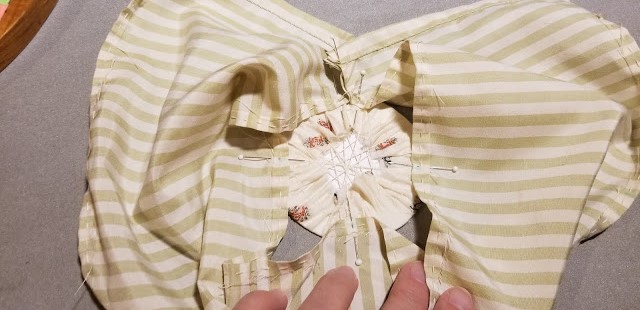
Start pulling the gathering stitch (on the body) to fit each quarter section together. Gently adjust the gathers to be evenly distributed. Pin in place as you go.


All quarters have been gathered and pinned in place. Note the 1" sections that have not been pinned to the medallion at the top of the photo.


The pinned reticule from the right side. It is now ready to sew the first medallion in place.


Use a small slip-stitch to attach the gathered body to the silk-covered medallion. Try to catch only the edge of the silk on the cardboard piece, this will help hide your stitches. Be sure to use small stitches spaced close together for a strong seam. Continue all the way around the medallion.


Another shot of the stitches attaching the body to the medallion.


The first medallion is now completely sewn to the body.


The right side of the reticule after the first medallion is complete.

You will repeat the above steps to attach the other outer medallion to the body. Once the second outer medallion is attached then the reticule can be turned inside out and the interior medallions sewed down. Attaching the interior medallions are fairly simple to complete. Just lay one medallion on top of all the interior stitches (one on each side) and attach using a small slip stitch.


One interior medallion is sewn in place in the same way at the outer medallions.


The 1" sections that were not sewn to the medallions can either be left open or sewn together closing the 1" gap. I chose to sew the gap closed. Unfortunately, I did not get a photo of this step. Place the two outside folded edges together and sew a small whipstitch over the edges. 

The last step is to run your ribbon through the channels. You will need two ribbons the same length (however long you want your ribbon straps to be). Starting on one side, run your ribbon through the channel using a long needle-shaped bodkin. Once through the first channel, bring it around through the other channel and tie it off. Repeat this on the opposite side. You will have two ribbons that when pulled will close the reticule.


Saturday, November 16, 2019

Two Embroidered Pockets: A Recycle Project

I love making something old new again. Time and money always seem to be in short supply in my household so any opportunity to reuse an item, I do it. I enjoy the challenge of figuring out how to reinvent things...give them a second life. Our foremothers did the same thing. They were very creative in their need to reuse clothing for example. If a garment was outgrown, worn out, or out-of-date, it was likely repurposed. I often say on tours at Stephenson House, our ancestors were the original recyclers. 

In my stash of fabric, I came across an old embroidered vest that someone gave me.  Today that old vest was going to become two embroidered pockets. 


This embroidered vest was originally made in India. The needlework looks to be hand done or at least passable.


For many years, I've wanted to make a lovely embroidered pocket. Unfortunately, time is a commodity in short supply for me. This old vest was going to solve the 'time' issue. It would cut out the many hours it would take to embroider the front of the pocket, allowing me to jump right into the construction. And instead of just one pocket, I'll have two!  

Pockets worn by our foremothers came in a variety of shapes since each one was made by an individual. Today we can buy a pattern to make what would have been cut-out or drawn traditionally. Kannik's Korner has a nice pattern that includes five different documented styles. You can also get inspiration online from a wide variety of museum collections then draft your own. 


The first thing was deconstructing the vest. I removed the buttons and cut out the front panels as close to the seams as possible in hopes of salvaging as much of the usable fabric. The front section with the buttonholes was cut off since I didn't want to mess with closing-up the holes. The front of the vest was lined with nice tan cotton that could be used as lining for the embroidered panel of the pocket. Once deconstruction was complete, all the pieces were pressed.


The panel on the left is slightly smaller because it had the buttonholes and I simply cut them off.

Tan cotton lining from the front panels. The interfacing was cut off.

Obviously, the size of the pocket was dependent on the size of the deconstructed front panels. Kannik's pattern provided five pocket sizes. Since the pattern paper was fairly transparent it made it easy to lay each on the fabric to check for fit. This also allowed me to play with the positioning of the embroidery design. All but one of the patterns was way too big for my little panels. The 'Mid-18th Century, Italian' pattern was the WINNER!

The pattern for the Italian pocket fit nicely. The transparency of the paper allowed me to play with the positioning of the embroidery design. Since both panels had symmetrical designs the pockets would too.

Kannik's instructions were simple and easy to follow. I did make some minor changes. Since the deconstructed panels were large enough to allow for slightly bigger pockets, I cut the pieces about 1/4" bigger than the actual pattern. It wasn't much but I wanted to use as much of the panel as possible. The lining piece and back piece were cut the same size. Altogether there were three pieces cut for each pocket; front, front lining, and back.


Pocket front cut about 1/4' bigger than the pattern piece.


Tan lining was cut the same size as the front.


Both pocket fronts cut out and marked. Since the vest front had the same design on both front panels I was able to mirror the design fairly well. The blue line at the top of each is the pocket slit.


Once all the pieces were cut the assembly could begin. I marked the front piece where the pocket opening would be cut (see the blue line in the above photos). Kannik's instructions called for the slit in the front and lining pieces to be cut at this point but I decided to wait on this step since the embroidery might fray due to handling. 


The tan lining is placed on the bottom of the stack. The striped fabric is the back piece and it is laid on top of the tan lining. The last piece on the stack is the front with the right side down.


I stacked all of the pieces in the following order: lining, back piece and front piece with the right side down. This order will make sense when the pocket pieces are turned after sewing the side seam. The photo below shows both pockets stacked in layers ready for pinning.

All three pieces of each pocket are stacked and ready to be pinned. 


I marked my seam allowance with a fabric marker to keep my seam in its proper place as I sewed around the pocket.


A small spaced back-stitch was sewn through all three layers of fabric.


Another shot of the spaced back-stitches.


Stitching around the pocket is complete. Time to turn it.


Turning the pocket right-side-out. Since there are three layers to the pocket, turning needs to be done between the front and back pieces. The back and lining pieces are treated as one in this step.


The pocket turned right-side-out. In this photo,
 the lining is now in the center of the three pieces and the side seam encased between the lining and the front piece.


Now that the pocket is right-side-out the seam was pressed and the opening slit marked down the center front (blue line). I used the slit measurement provided on the Kannik's Korner pattern.


Following the center front slit marking, I cut through both the front and lining fabric. The back piece was not cut!


The cut edges of the front and lining pieces were matched-up and a running stitch sewn around the slit. This will help hold them together when the binding is sewn on.


Inside view of the running stitch holding the front and lining pieces together. The cut edge/running stitch will be covered with binding.

Now that the pocket body is sewn together, a binding piece was needed to cover the pocket slit. I made my binding out of the same striped fabric used for the back. To make the binding, a 1" wide piece of fabric, long enough to go completely around the slit on both sides, was cut on the bias. Cutting it on the bias will make it more flexible, especially when it's sewn and shaped around the curve in the slit.


The bias cut binding is ready for pressing. This piece will bind the cut edge of the slit.


I folded the binding piece in half lengthwise and pressed it with the iron.


In this photo, the binding is pinned along the cut edge of the pocket slit. 


A small running stitch (with a backstitch every so often) was sewn about 1/4" from the cut edge. I was careful to catch all three layers: binding, pocket front, and lining.


This photo shows the inside of the pocket slit. The binding has been pressed out and is ready to be folded over the cut edge of the slit. Once folded over the cut edge it will cover the stitching.


Binding is folded over the slit edge and pinned.  All the cut edges are now enclosed.


A simple whipstitch attaches the binding edge to the pocket lining. I tried not to go through to the front fabric and only catch the lining.


Binding is complete.


Binding from the front.


Along the top of the pocket, a basting stitch was sewn to hold all the layers in place. Be sure to go through ALL the layers: front, lining, back. This will make the next step easier.


I used a piece of leftover binding to finish the top edge of the pocket. The piece needs to be long enough to go the width of the top edge with at least 1/4" seam allowance on each side. In this photo, I have more than a 1/4" on the ends. Going through all the layers, I then sewed a backstitch a 1/4" from the top edge (not pictured). Once this was complete, the binding was pressed up and folded over the top edge.


The binding has been pressed up and over the top edges of both pockets. It can now be whipstitched to the back piece.


Two pockets complete. All that is left is to add a waist tie. I used some woven 1/4" tape purchase from William Booth Draper (not pictured).


All done! They work great with my petticoat which has slits on each side for easy access. In this photo, I am modeling them on the outside of my petticoat.  Normally I wear them under my petticoat. Since they are sewn to a waistband/tie, they sit on my hips for easy access through my skirt slits.