Showing posts with label mourning. Show all posts

Friday, October 8, 2021

Letters from Lucy Stephenson: September 27, 1820


 **Written in September 2021 by RoxAnn Raisner (house director) in the voice of Lucy Stephenson and published in the online Edwardsville Intelligencer, October 6, 2021, https://www.theintelligencer.com. Based on historical facts, current happenings at the House, and a historians vivid imaginings. Follow Letters from Lucy Stephenson on Facebook (facebook.com/LettersfromLucy).


September 27, 1820
Edwardsville, Illinois


 Dearest Mary,

     It is with a very heavy heart that I write this letter. Unfortunately, we have not escaped the encroachment of summer fever sweeping across the region and mourn the loss of so many. It seems hardly possible that mere few weeks ago all was well, only to find ourselves caught unaware by a loved one’s sudden and complete departure from this world. How I ache from it daily. Preparations are being made so our house may observe a period of mourning. My daughters, Julia and Elvira, have begun the task of washing, airing, and mending clothing suitable for the expression of our loss. And, Winn has set to task picking apart some old garments to dye black and refashion. This morning, I sent an order to the fabric merchant in Belleville to procure several bolts of bombazine so we may sew-up some additional mourning attire for the entire household since it will be some time before we are unburdened by grief. The wool crepe bunting now hangs above our door so that all those who pass may be aware of our sorrow.

     Winn, in her infinite ability to be prepared, has baked several batches of funeral biscuits embossed with cherubs and crosses for mourners attending the funerals to pay their respects. I visited the newspaper in lower town yesterday to procure an order of small, printed remembrance wrappers to cover the biscuits, as well as several pieces of black sealing wax from Mr. Poage’s store to use in the closure of each. I find having a useful occupation keeps my mind from dwelling for too long on that which I cannot change. The reprieve does not last long, of course. I know you will want a copy of Winn’s receipt for the funeral biscuits so I shall include it. It’s quite simple and they store exceedingly well for long periods of time. I find many guests chose to keep their biscuit as a memento mori as opposed to eating them at the funeral.


Funeral Biscuits

Take twenty-four eggs, three pounds of flour, three pounds of lump sugar, grated, which will make forty-eight finger biscuits for a funeral.


     Dr. Todd, our local physician, has truly been a godsend the last weeks. Besides attending to countless families suffering from the summer fever’s, Ben’s ague recrudesced quite suddenly. As you well know, for some time now, Ben has been plagued with bouts of this insatiable illness. Some episodes far worse than others. Admittedly, this particular recurrence was quite arduous, causing me great concern as to his safe recovery. The severity, at one point, warranted the need to send for Rev. Ballard who provided much comfort through his ecclesiastic ministering and friendship. Thankfully, a new shipment of yellow bark arrived a Poage’s store to which we procured two orders before the supply was depleted from demand. After several days of treatment, it appears the most critical time has passed. Ben appears to be returning to health, slowly, but I do believe we owe much to both Dr. Todd and Rev. Ballard. I fear the probable outcome without the succor of both.

     Well, my dearest friend, I must close this letter for there is much to attend to. Hopefully, my next will contain happier news and these dark times shall be left behind as distant memories. I pray you stay well. Please write soon so that I may have something to brighten these bleak days. Give my love to all and know I hold you in high regard, as always.


Yours In Friendship,


Lucy Stephenson

Notes:

Bombazine was a fabric used for mourning clothing in the early 19th century. It was a silk and wool mixture with a very flat appearance. It is no longer made. The closest fabric resembling it today is wool crepe.

The Funeral Biscuits receipt (recipe) was published in the 1828 (5th Edition) of The Whole Art of Confectionary: Sugar Boiling, Iceing, Candying, Jelly Making, &c. by W.S. Staveley. These biscuits were commonly given out at funerals and often wrapped in paper with the deceased name, poem, and/or information about the person printed on the outside and sealed with black sealing wax stamped with a funerary image such as skull and crossbones, cherub, rooster, cross, heart, etc.

Ague is the historical term for malaria. At the time, it was treated with a bark from South American known as yellow bark, Jesuit bark, lima bark, or Peruvian bark. The bark contained quinine and was the most effective treatment available at the time.

Col. Stephenson died on October 10, 1822, from what historians believe to be malaria. The museum will host Mourning Col. Stephenson: A Special Exhibit from September 30-October 31. 

Friday, October 18, 2019

Making an Early 19th Century Mourning Dress: Skirt, Bodice, and Bib

Skirt, bodice, and bib are together.
The dress is starting to look like something. The bodice, skirt, and bib are sewn together but do not have any lace trim, buttons, or hem yet. The sleeves are underway but not yet ready to attach.  Drafting out the bib (or should I say experimenting) took more time than expected. It's actually a fairly simple construction but I had to wrap my brain around how to put it all together and make it work.

As stated in my two previous posts, the pattern I'm using for the bodice and skirt is Laughing Moon #126 Ladies Round and Trained Gown with High Stomacher Front, c. 1800-1810. The bib started out as a combination of two of the LM bib options with modification by me to resemble the inspiration piece sold on eBay as a study garment. Overall I'm pleased with how it turned out. The bib is not an exact replica of the inspiration bib but that's kinda hard without having it to draft a pattern from.

Anyway, here is the progress so far.


Attaching the Skirt and Finishing the Bodice
When attaching the skirt, I didn't follow the instructions on the LM pattern very closely. I've studied several extant dresses over the years so I ended up attaching the skirt similar to how our foremothers did it. Instead of sandwiching the skirt pleats between the bodice and lining, I sewed the back panels to the bodice and lining as one then pressed the seam toward the skirt. I did use the LM pattern's placement marks on the bodice to know exactly where the skirt panels needed to be set.  My choice in attaching the skirt is a personal one. I like the way the skirt hangs better when the bodice and lining are treated as one. This choice is by no means a reflection on the instructions included with the LM pattern, which are great BTW. Laughing Moon has excellent patterns and instructions but I have a tendency to add my own twist to things (or as some of my associates would say, "reinvent the wheel." It a form of self-torture. ðŸ˜‚)


Back skirt panels are sewn to the bodice (outer bodice and lining are treated as one) using the patterns recommended seam allowance of 5/8" then the seam is pressed toward the skirt.


Another view of the skirt and bodice seam.


Now that the back skirt panels were sewn in place, the bottom edge of the front bodice could be completed. A small cut was made on the bodice piece about a 1/2" behind where the bodice/skirt seam ended (I did not cut through the seam though, just to it). This cut is visible toward the left of this photo. 

The cut edges of the lining (brown fabric) and outer bodice (black fabric) were turned in toward each other and pinned. The lower edge of the lining flap (brown section in the photo above) was folded under itself and pinned. Now, the bottom seam of the bodice could be sewn together. The lining edge was whip-stitched (brown fabric). The bodice (black fabric) and lining (brown fabric) were prick-stitched together, creating a very flat seam. The front edge of the lining flap was also finished at this point even though it's unfinished in the photo. I folded it over 1/4" twice then whipped-stiched it down.


Here is a close-up of the cut made on the bottom of the bodice edge (two pictures above). The lower seam of the bodice is now complete but the cut area needed to be overcast to keep it from fraying.


Interpreting the Original Bib Construction
Time to tackle the bib piece. It took some thinking but I'm pretty good at Tangrams so it was kinda fun. I downloaded all the photos of the inspiration bodice I could find then studied them as close as my computer resolution would allow. My bid is not an exact copy but I'm pretty pleased with the final product.

Below are the four photos I used to figure out how the original bib was constructed. As mentioned in a previous post, this bodice was the only part of a c. 1800 gown to survive. It was sold on eBay but very little information was available on it.


The extant bodice date 1800.


Each side of the original bib appears to be made up of three sections with a centerpiece down the middle.  Without actually having the bodice to examine I had to make several assumptions on how it was put together. The assumption I went with was that each half of the bib was created separately and connected with the centerpiece. The buttons are purely decorative.

The inside view of the bib appears to support my assumption stated in the previous photo. The only lining is at the top of the piece and possibly the lower half. The snap is definitely a much later addition to the garment. For those who are unaware, snaps didn't appear on clothing until the late 1800s.

Side view of the original bodice. Such a lovely piece....sigh.


My Method of Attack! (aka The Weird Way My Brain Works)

After studying the photos as closely as possible, I decided to make each half of the bib separate. I used the smaller of the two gathered bibs in the LM pattern as a starting point.


I copied the LM gathered bib pattern (the smaller of the two gathered bibs in the pattern) then sectioned it into three pieces. The center section needed to be angled out to the sides, making it wider to the outside and narrower toward the center. Marking each section was important because keeping the sections in order was not as easy as you'd think.


The upper and lower sections cut out. A 1/4" seam allowance was added to the top piece's bottom seam and the bottom piece's upper seam. There was no need to incorporate additional seam allowances anywhere else since it was already figured into the LM pattern piece. The 1/4" seam allowance was very small but so was the originals. It could have been bigger but I chose to keep it narrow.

Three inches were added to the side of the center section when I cut it out. This could have been longer but I didn't want it to be overly full when all the pieces were sewn together. Seam allowances of  1/4" were also added to the top and bottom of this piece.


After sewing a gathering stitch on the top and bottom of the center section, I gathered it to fit the bib top and bib bottom sections. Here is it pinned in place and ready to be sewn.


This image shows the bib top and bib bottom sections pinned and ready to sew to the gathered centerpiece. This is the same image as above just flipped over.


All three sections of one half of the bib have been sewn together and pressed. The top section's 1/4" seam was pressed up and the bottom section's seam pressed toward the bottom. Another bib half will be sewn and the two pieces joined in the middle to create the full bib.


A small spaced back-stitch was sewn the length of each bib section, on the right side, to secure the seams and add stability. 


At this point, I realized that I hadn't added a seam allowance to the side of the bib pieces where the two halves would be joined (center front of the entire bib). In theory, the three-sectioned bib pieces could have been cut on the fold (like the LM pattern instructions) but, alas, they weren't I hadn't accounted for a center front seam....sigh.  So I had to punt. I ended up pinning the two halves together down the center front and running a small overcast stitch along the edges. The stitch was firm but not tight so that the seam could be opened up flat when complete.


I worked the tiniest overcast stitch possible in order to join the two bib halves together down the center front.  This join butted the two halves together without creating a wide seam. 

The completed center join once it was opened and pressed. A center strip will be added over the top of this seam.  The purpose of the seam was simply to join the two bib halves together with the smallest seam possible. You can see some of the overcast stitches holding the two halves together in the photo.


Both halves are joined together. 


I cut a 1" strip of fabric for the centerpiece of the bib.


A 1/4" of each side was folded over and pressed.

The strip was laid on top of the bib's center seam and pinned. The strip was sewn in place with a small whip-stitch hidden on the sides. A spaced back-stitch was also sewn the length of each side.


I wanted the bib to be lined but not with anything bulky that would affect the drape of the outer fabric. In my stash, I had some thin navy colored silk. I taped all the bib section pattern pieces back together and cut out a lining on the fold.


The sides of the bib lining and outer fabric were folded to the inside 5/8' and pinned. I prick-stitched the sides for a nice flat seam. The top edge was folded over to create a channel for a drawstring and pinned. A simple whip-stitch was used on the drawstring channel edge, being sure to catch all layers of fabric.


Close-up of the sides and drawstring channel before sewing.


The lining on the bottom of each side was left loose until the bib could be attached to the front skirt panel. Here is it folded up and out of the way for the time being. The bib was attached using the instructions for the LM pattern. The lining will be finished once the ties are attached to the front skirt panel.


The bib is sewn to the front skirt panel as seen from the right side.


In this photo, the skirt ties are being attached. These overlap slightly the section where the bib attaches to the front skirt panel. I followed the instructions from the LM pattern for this so I won't go into the details since they are explained very well in the pattern.


Once the ties were attached, the bib lining could be finished. The sides (left unfinished above) were prick-stitched to the outer fabric. The bottom of the bib was folded under and matched to the seam (created when the bib was attached to the front panel) then whip-stitched down.


Almost done. Not be bad if I do say so myself. 


The finished bib. Three button molds were covered in wool crepe then sewn down the center front. These buttons are purely decoration. Two additional fabric-covered buttons were attached to the bodice. Simple ribbon loops were sewn to the top corners of the bib. These loops go over the bodice buttons to keep the bib in place.


The Hem
Now that the bib was complete, I could put the hem in. This was going to require a helper so I went to visit my friend Dottie. Without her help, the hem would have been a disaster. After a couple hours of fussing with the line, the hem was finally ready to go in.

To help keep the skirt from draping limply at the bottom, Dottie suggested using horsehair braid. Skirts in the 1820s had a distinct bell shape. I could have stuffed the hem to give it shape but I took Dottie's suggestion and purchased some modern horsehair braid (1" wide). No, horsehair braid is no longer made of real horse hair but it used to be.

In this photo, I've measured, marked and pressed the hem 1" plus 1". The horsehair braid is folded into the first fold of the 1" hem then pinned to hold it in place.

Better image of the first hem fold with the horsehair pinned in place. Now it will be folded over again to completely enclose it.

A hemstitch the holds everything in place.

To be continued..........


Other posts related to this project

Making an early 19th-century mourning dress

Making an early 19th-century mourning dress: The Skirt

Making an early 19th-century mourning dress: Sleeves


Making an Early 19th Century Mourning Dress: The Skirt

The skirt was a fairly simply affair to work on today. I decided to use the skirt pattern pieces that were part of the Laughing Moon #126 pattern instead of drafting out an entirely new one. The base for the bodice was from the same pattern so there would be no thinking or planning involved....easy peasy.

The skirt (c. 1800-1810) will be a bit narrower than what would have been fashionable in 1820 but I'm not too concerned.  Extant images and garments from this period in St. Louis show lots of skirts similar to this one. Also, I've no doubt that a woman of my age had items in her wardrobe spanning more than one or two years. I have several items in my closet today that are older than 10 years so there's no doubt in my mind that my 1820 persona would too. Garments were often remade or refashioned to reflect the times. It's a reasonable assumption that a dress, as long as it was in wearable shape, would continue to be worn.  Okay, I'm done soapboxing.

Let's get to it.

I laid out the fabric and cut out the two back panels. The front panel had already been cut out. Once cut, I had three pieces: two large back panels and one front panel cut on the fold.  I did transfer all the pattern markings to the panels but ended up using only the one for the side slit (which I went ahead and cut during this step). My skirt would not be attached in the same fashion as the L.M. pattern instructed.


The two back panels were sewn together and the seam pressed open. I did not add the front panel yet. It will be sewn on later.


Back panel seam pressed open.


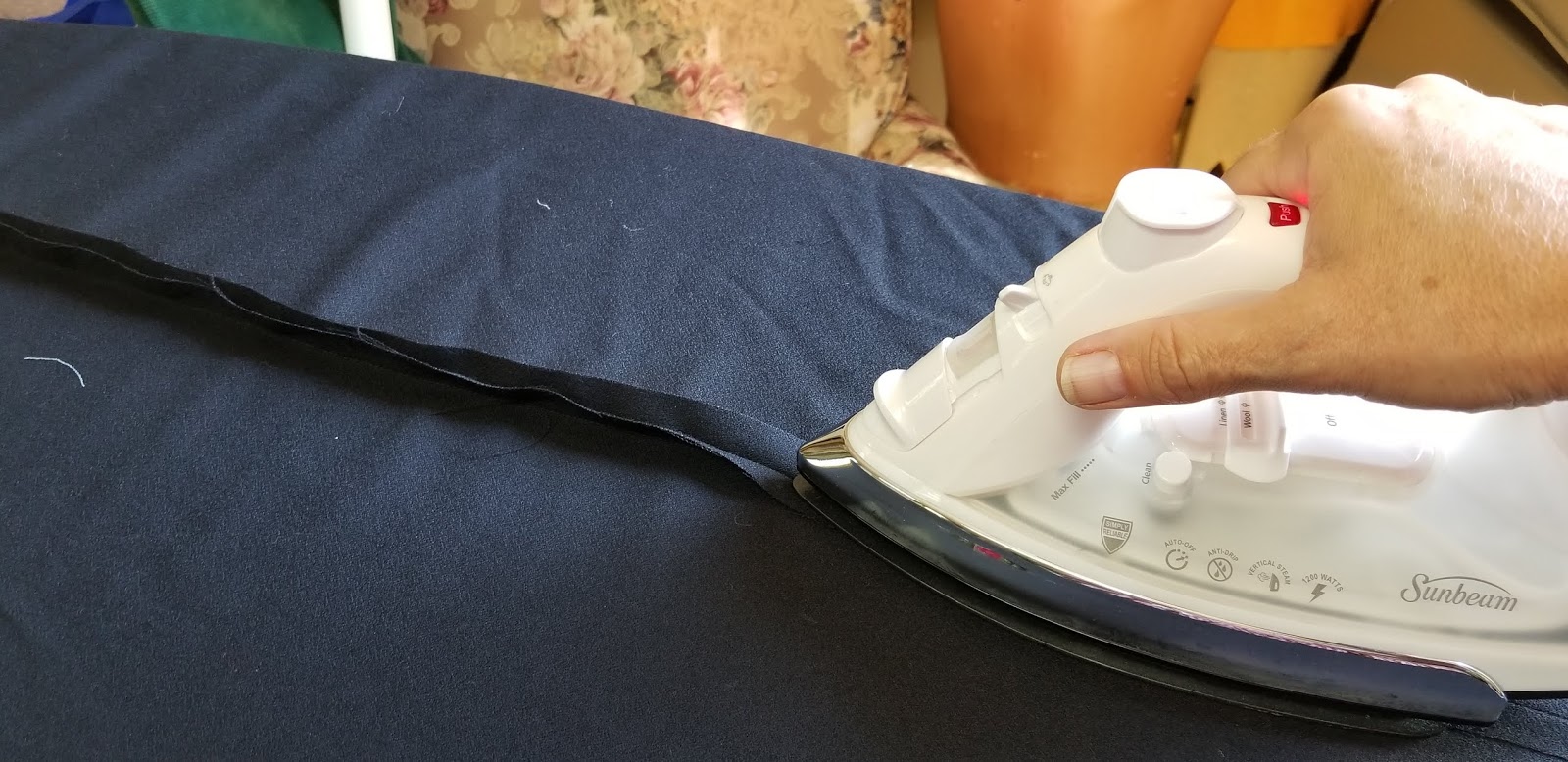
The side slit was folded over about 1/2" starting at the top of the opening then tapering to nothing at the bottom. Then the cut edge was folding under itself again creating a very small edge to be sewn down.

The slit edge is pinned and ready to sew.


At the bottom of the slit, where there was not enough fabric to fold over, I whipped-stitched the curve. This helps reinforce a weak area. I will add some reinforcement to keep it from ripping out during use in the next step.


Once the slit was completely stitched, I placed both sides of the slit together and pinned it closed at the bottom. The area that curves slightly up on the right is the bottom edge of the slit.


I whip-stitched the bottom opening of the slit about 1/4"-1/2" to give it some stability. The photo shows the very bottom edge where it is the weakest.


The stitched only caught the top edge of the fabric otherwise it will create a noticeable 'pucker' on the outside of the panel. I only want to give it some extra reinforcement at the lower edge not sew a massive seam.


How the finished reinforcement looks from the outside of the panel. This is less than 1/2" long.


Now that the side slits are both sewn the front panel could be added. I didn't want to wrestle extra fabric until it was necessary. 

The front panel, back panels and slide slits are complete. At this point, I have a large tube. I'm ready to attach it to the bodice.


To be continued..........


Other posts related to the project

Making an early 19th-century mourning dress

Making an early 19th-century mourning dress: Skirt, Bodice, and Bib

Making an early 19th-century mourning dress: Sleeves


Monday, October 7, 2019

Making an Early 19th Century Mourning Dress: Sleeves


It's finally time to work on the sleeves for my mourning dress. I wanted something a little fancier than I usually wear. Typically, I don't like short, puffed sleeves on my dresses (for a variety of reasons) but several period images kept catching my eye. All of the sleeves had a short, puffy top sleeve with a sheer lower sleeve. My dress is very simple but sleeves like these will offer some visual interest and period style for a very somber dress.  Below are the inspiration images


Madame Angelica Catalini by Rolinda Sharples, c.1814-1821. Smithsonian National Portrait Gallery

Mourning dress in the MET collection, c 1820

The Duchess of Kent and Princess Victoria by Sir William Beechey, c. 1821


As mentioned in previous posts, the pattern used as a base for my dress is Laughing Moon #126 Ladies Round and Trained Gown with High Stomacher Front, c. 1800-1810 with modifications made to the bib. The sleeves in LM #126 were not quite the shape or style I was looking to recreate but they weren't too far off.  Last year I had made a ball gown for the Stephenson House that incorporated the sheer poofed sleeve from  Laughing Moon #138 Ladies Regency Gown, c. 1815-1825. The #138 sleeve was beautiful and exactly what my dress needed to take it into the 1820s. I decided the original sleeve pattern would be combined with #138. The sleeve from #126 incorporated the following from #138; it was shortened, slits were added, and poofs cut.


The original sleeve from #126 was shortened to resemble the sleeve from pattern #138. 


The sleeve's interfacing of wool crepe is marked for slits and pinned to the right side of the sleeve.


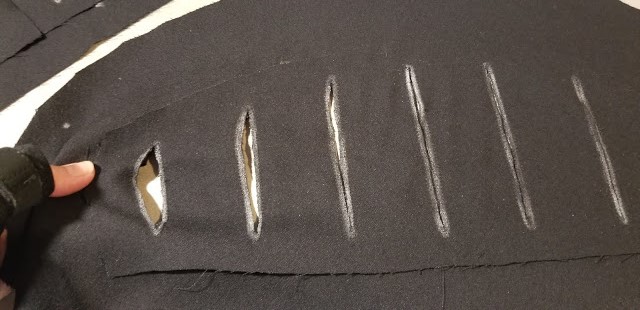
Using the sewing machine, I sewed around the outside of the slit markings on both sleeves.


Once all the slits were sewn the centers were cut open with a pair of sharp, pointed scissors.


The wool crepe interfacing was cut between each slit so it could be turned to the inside of the sleeve.


The bottom sleeve in the photo shows the interfacing turned to the inside and pressed.


Close-up of the right side of the sleeve once the interfacing was turned to the inside and pressed.


Close-up of the inside of the sleeve after the interacting was turned and pressed.


This is one of the silk 'poofs' that will be sewn into the sleeve slits. There were 14 in total. Unfortunately, I did not get a photo of the 'poof' before the gathering stitches were put in. This is how it looks after the gathering stitches were pulled to create the fullness. The instructions in LM #138 do a great job explaining how to attach each piece so I won't go into detail.


It so hard to see what's going on here because of the black on black. Just below my thumb is the silk 'poof'. I'm sewing the gathered poof into the slit with a spaced-backstitch all around the edge of the slit.


Three of the fourteen 'poofs' are attached.


One sleeve with all the 'poofs' sewn in.


How the sleeve looks from the inside once all the 'poofs' were attached.


Because of the weight of the sleeve, I decided to add a partial lining at this point. It's the same polished cotton used to the line the bodice. 


I have no photos of the sleeve being attached to the bodice. None of them really turned out. The black on black made distinguishing what was going on to difficult. Since I had chosen to just modify the original #126 sleeve while keeping the basic shape, all of the pattern placement instructions provided by Laughing Moon would be the same.

For the lower sleeve, I wanted something more fitted than the pattern piece from LM. This sleeve piece would be made out of sheer silk chiffon I found at Fashion Fabrics Club in St. Louis for $15.95 a yard. It was perfect for my lower sleeves and a new neckerchief. This is also the fabric used to make the 'poofs' in the upper sleeve.

Obviously not sheer silk. I did a couple mock-ups of the lower sleeve in order to get the fit I wanted. The sleeve is very long in this photo but after it is hemmed and a wrist band added, it will be the perfect length.


Getting ready to cut the silk. The fitted pattern was cut on the bias to give the sleeve more movement and stretch when I wear it.


Now, if I had been smart I would have sewn a french seam on the lower sleeve instead of the flat -felled seam but hindsight is 20/20. It didn't even occur to me until I'd already sewn in the flat-felled seam that the french seam would have been so much easier (and probably prettier). A rolled hem would be used to finish the wrist edge (not done yet in this photo). At the top, I folded over the edge 1/4" plus another 1/4" and back-stitched it (not done yet in this photo).


Flat-felled seam ready for sewing. Isn't this fabric gorgeous?

Here the lower sleeve is being attached to the upper sleeve. This view shows both sleeves inside out. The lower sleeve is being whip-stitched to the top of the upper sleeves armband. 

The lower sleeve attached to the upper sleeve. All that's left is to create a wristband.


The wristband was cut from the wool crepe the circumference of my wrist plus 1/2" for seam allowance and 1/2" for overlap to close it. The width was roughly 1  1/2". All sides were folded in 1/4" and pressed (the upper piece in photo). Then the band was folded in half lengthwise (the lower piece in photo), pressed, pinned, and all edges were whip-stitched closed.

 A hook was added to one side of the band and a thread bar to the other. This would enable me to close the band around my wrist. 


One short edge of the band was attached to the seam of the lower sleeve about 2" from the wrist edge. The band would hang free of the lower sleeve with the exception of the one short edge sewn to the lower sleeve seam.


THE COMPLETED GOWN!


I have to say I'm VERY pleased with the final gown. This is the fanciest gown in my wardrobe. Usually, my interpretation is of a working-class woman not a fancy widow in mourning. It will be easy to use this dress for other occasions by simply changing my accessories or adding an overdress. I could even pull off 'strict' schoolmistress with some spectacles and ruffly white day cap tied under my chin....😂 Upcoming school tours better watch out! LOL!


Close up of the front. My mourning jewelry is made of silk ribbon with a glass locket containing a miniature portrait of my father. It is attached to my bib with a removable straight pin.

And the back view.  Pardon my shift peeking out.


And it's done! Now on to the next project.


Other posts related to this project

Making an early 19th-century mourning dress

Making an early 19th-century mourning dress: The Skirt

Making an early 19th-century mourning dress: Skirt, Bodice, and Bib