Showing posts with label historical demonstrations. Show all posts

Thursday, September 16, 2021

Lucy Takes a Bath: A Night Routine in 1820

  
My family portraying the Stephensons.
     We've been making YouTube videos at the site over the past year. Actually, one of the site's interns had been filming and producing the videos, the rest of us were actors, supplied some of the historical contexts for the early videos, and provided the setting/props. It's was great fun. 
 
     I'm not one for being on camera let alone playing the lady of the house but due to COVID-19, I was drafted from laundress to lady. My husband in real life portrays Col. Stephenson, the man who built the house in 1820-21. He's featured in one of the first videos where we discuss how a gentleman of the early 19th century got dressed. Filming began in December 2020 but due to the pandemic, we couldn't bring in lots of outside reenactors. That's when I was promoted to playing his 1820 wife Lucy Stephenson. Our sixteen-year-old daughter got in on the fun too as Stephenson's oldest daughter Julia. It became a genuine family affair. 

     In my first independent video as Lucy Stephenson, I showed a possible scenario for a lady's nightly routine. Most of my friends have had quite a bit of fun telling me how risque it is since I do undress and take a bath on camera (all done with 1820 modesty in mind, of course...No Nudity! Lucy only undresses to her shift, even to bath). Regardless of the ribbing I've taken, it was a lot of fun to make. I'm amazed at the interest that's out there regarding something as mundane as taking a bath but I suppose it shows an aspect of daily life that many people are curious about. 

Lucy (aka me) in her bath.
     There is a common misconception that people in the early 19th century were filthy and rarely bathed. For some reason, we like to believe that our ancestors were dirty and ignorant when in reality, they were far from either. It's true, a full-bodied bath, where one got into a tub to wash, was not something that was done every day; maybe every couple of weeks. There was a fair amount of work involved in preparing, taking, and emptying a bath before the convenience of indoor plumbing. Most people washed up in some way each day either in the morning, evening, or both. A simple washbasin, water pitcher, bar of soap, and a washcloth/sponge were sufficient to remove the dirt of the day. We'd call this a sponge bath today. Another alternative to the bathtub would have been to visit a local watering hole such as a creek, river, or pond. As modern Americans, we tend to be obsessive about bathing and showering but that just wasn't an option in the early 19th century. Another thing to consider would have been a readily available supply of water. Where did your water come from and how was it stored? Rain barrels? A well?  If you were experiencing a drought, priorities changed. What is more important bathing or water for the household and livestock?  Yes, if you traveled back in time you'd probably be overwhelmed with a plethora of smells we do not have to deal with today but that isn't necessarily an indication of uncleanliness. 


A small bowl, sponge, and pitcher were often used daily to clean the body.


     The tub I used in the video is called a hip bath. It is just one type of tub that was available to our forefathers and mothers. There were much larger tubs where you could be submerged similar to our modern full bathtubs but this small tub was easily portable and didn't require tons of water. Our tub is made of tin and can be lifted easily with one hand. In the photo below, the tub is lined with a linen bathing sheet. This sheet helps to protect your delicate parts and skin from metal that would get quite warm when hot water was added or even rust depending on the type of metal used; ours is tin so it would tend to rust if not dried properly after use. Wooden tubs had a tendency to splinter after repeated use so a bathing sheet was standard equipment on bath night regardless of what type of tub you were using.


The Stephenson House's tin hip bath is lined with a linen bathing sheet.

     Obviously, a hip bath is not going to require a lot of water which was definitely more convenient for whoever was going to be hauling the water, heating it, or emptying the bath. In many ways, it's just a step up from a bowl and pitcher sponge bath. In our video, I have someone helping me bathe which was a common practice for someone of Lucy Stephenson's economic standing. Altogether, we used only three pitchers of water to complete the bath; any more and the tub would have overflowed. Once an adult-sized body sits in the tub there is very little room for excess water. Bathing next to a hearth (with a fire) allowed for kettles of water to be heated and kept warm for use.  Most likely a pitcher of warm water was poured over the seated (or standing in the tub) bather who then soaped up a sponge or cloth for washing their wettened body. Once all areas were cleaned then another pitcher may have been poured over the bather to rinse or the water from the tub reused.


        Many viewers asked why I wore a shift to bathe in during the video. Well, firstly I was not going to strip down to my birthday suit to be filmed bathing then have it posted on the internet for all creation to see. I love history but there's not enough money in the world to convince me to do that on camera.  Secondly, and most importantly, it was a common practice in the early 19th century for a lady to wear what was called a bathing dress, bathing gown, or bathing shift to maintain her modesty. Historical images depict women of various social classes bathing all-natural as well as covered, so either is correct. I chose to interpret a more modest Lucy and wear a bathing shift while being assisted by another member of the household.  Once the bath was complete a fresh clean, dry shift was donned before finishing the nightly routine and retiring to bed.

     Before moving on to the rest of Lucy's nightly routine I want to dispel two bathing myths that historic sites often perpetuate. Let me be perfectly clear, the following are myths...lies...untruths, so please stop repeating them. My mini-rant shall begin in five...four...three...two...one...


  Myth #1 "Don't throw the baby out with the bathwater" deals with the bathing practices of ancestors.

     Oftentimes historic site docents state this myth as a historical fact when referring to the bathing practices of our forefathers; which often required family members to take turns bathing with the same bathwater being used by each. This was an easy way to conserve water and labor. The theory behind this saying is that by the time the last child bathed the water was so milky and dirty that mothers would throw out their babies because they didn't see them in the tub. Why is it assumed the baby was the last to be bathed? How on earth would a mother who had just finished bathing her child suddenly forget they were in the water? It's so far-fetched it's ridiculous! In truth, this saying is a very well-known German idiom first documented in the print Narrenbeschwörung (Appeal to Fools) by Thomas Murner, 1512. Essentially it means, don’t throw out something valuable with something worthless. There is no documented historical reference to anyone throwing their baby out with the bathwater or of this even being a possibility. 


  Myth #2“People only bathed once a year.”

     First of all, YUK! And, no they did not! A daily bath was not as convenient as we find it today but that does not mean they were filthy. To only bathe once a year would have caused all kinds of health problems. Granted, a full-body bath (where everything was submerged in a tub of water) was done less frequently; typically every two weeks or so. Thanks to modern indoor plumbing, bathing or showering on a daily basis is typical for most of us; but preparing a bath in the 1820s would have been a major undertaking. Water had to be hauled up from the well and brought to the kitchen for heating then carried to where the tub was sitting. Once the bath was complete, the tub had to be emptied by hand and the water carried out of the house. The entire process was labor-intensive and time-consuming. It was more common for people to take a “sponge” bath at the end of the day, washing body parts that had been exposed such as the face, neck, and arms.

      Rant finished! Time to move on to skincare and the remainder of Lucy's possible nightly routine.

     When getting ready to film this video I thought very hard about how my modern nighttime routine might be similar to what Lucy may have done before bed. What types of skincare products might she have used to help smooth sun damage or stave off aging? In an effort to gain a better understanding of historical cosmetics available and those commonly used during the early 19th century, I contacted  Alicia Schult of LBCC Historical Apothecary. She thoroughly researches a variety of historical skincare receipts (the period term for recipe) then accurately recreates them to sell in her Etsy shop. Her expertise was invaluable in formulating what Lucy may have used on a regular basis.  Alicia recommended the following nighttime routine based on information from the 1811 publication Mirror of the Graces or the English Lady's Costume, as well as, her extensive research. 


Lucy's dresser shows a variety of skincare items used in the video.

     
     The first item I applied to my skin using a small natural sea sponge was Elder Flower Face Wash. This astringent wash according to Alicia  "helps fight wrinkles, acne, scars, sunburns, evens out and softens your skin." Mirror of the Graces refers to this type of wash on page 221.

Unction de Maintenon
The use of this is to remove freckles. The mode of application is this; - Wash the face at night with elder-water flower, then anoint it with unction. In the morning cleanse your skin from its old adhesion by washing it copiously in rose water.
Recipe: Take of Venice soap an ounce, dissolve it in half an ounce of lemon juice, to which add of oil of bitter almonds  and deliquidated oil of tarter each a quarter ounce. Let the mixture be placed in the sun until it acquires the consistency of ointment. When in this state add three drops of oil of rhodium and keep it for use.   


Pictured are several sea sponges, Elderflower Wash (tall bottle), Virgin's Milk (center), Lily Pomatum (short jar), and Milk of Roses (back right).


        An application of Virgin's Milk followed the elderflower wash and was also applied all over my face and neck with a clean sea sponge. This step was not included in the video but would have been part of many ladies' nightly routines. The receipt used to create this particular Virgin's Milk dates to 1825. It contains Balm of Gilead, (anti-inflammatory, anti-microbial, and analgesic), Storax (promotes healing and overall skin health), and Gum of Benjamin (anti-inflammatory, antiseptic, soothing). Virgins' Milk was used to combat acne, age spots and to keep the skin looking youthful. This item is currently not available through LBCC's Etsy shop but an alternative product would be Milk of Roses; which has similar properties and was very popular in the early 19th century.

Virgin's Milk (page 229, Mirror of the Graces)

The Tincture of Benjoin is obtained by taking a certain quantity of the gum, pouring spirits of wine upon it, and boiling it till it becomes a rich tincture. If you pour a few drops of this tincture into a glass of water, it will produce a mixture which will assume all the appearance of milk, and retain a very agreeable perfume. If the face is washed with this mixture, it will, by calling the purple stream of the blood to the external fibres of the epidermis, produce on the cheeks a beautiful rosy colour; and, if left on the face to dry, it will render it clear and brilliant. It also removes spots, freckles, pimples, erysipelatous eruption, &c. if they have not been of long standing on the skin.

     Lily Pomatum finished the administerings to my face cleansing and skincare routine. This particular receipt was created in 1772 as a wrinkle cream but it had many other benefits including treating dry skin, spider veins, scars, sensitive skin, and burns. It contains Lily oil which smells wonderful. Once applied it makes the skin appear shiny and was left on until morning then washed off. 

     The next step, and probably the most interesting part of reenacting this nightly routine, was to wash my eyes. Yes, you read that correctly, I washed my eyes. This was very much a thing done by ladies of the period. It was believed that bright clear eyes were an indication of good health. I did NOT however use an actual period eyewash since the one listed in Mirror of the Graces (and most receipts at the time) called for camphor as an ingredient. CAMPHOR SHOULD NEVER BE USED IN YOUR EYES!! EVER!!! IT IS POISONOUS! IF IT GETS INTO YOUR EYES OR BLOODSTREAM IT CAN CAUSE BLINDNESS, ILLNESS, OR DEATH. There are references to eyewashes containing blue tint to make the eyes appear brighter. For the video, I simply used an eye cup similar to what they used (and still available today) and a contact lens solution. Honestly, my eyes did feel great afterward so I can understand why they liked washing their eyes. But again, DO NOT USE A PERIOD EYE WASH RECEIPT! 

An excellent Eye-water (page 233, Mirror of the Graces)

Take 6 oz of rectified spirits of wine, dissolve it in one drachm of camphor, and half a pint of elderflower water. Wash the eyes night and morning with this liquid, it clears the vision and strengthens the eyes.


The eye washing cup I purchased online along with the bottle I filled with contact lens solution.


     Once my eyes were nice and clear I moved on to cleaning my teeth. The toothbrush I used was a simple brush that LBCC offers made of bamboo...even the bristles are soft bamboo and a type of nylon. Granted our ancestors didn't use bamboo or nylon but the final product is passable for a period wooden toothbrush with boar bristles, plus it is biodegradable and good for the environment. The toothpowder consisted of ground clove, rose, sage, nutmeg, and lemon. The receipt LBCC uses is documented to be much older than 1820; it actually first appeared in 1653. The basic receipt didn't change much over the years but some ingredients added in the early 19th century were less than healthy for you (of course, LBCC's receipt is safe and uses only healthy ingredients). It's definitely not like modern toothpaste. It's gritter and doesn't get sudsy but my teeth and gums felt clean and refreshed. 


My horn cup, toothbrush, and toothpowder. My mouth felt great after brushing with these.


The final step to recreating Lucy's nightly routine was to curl or set my hair for the morning. Curls surrounding a woman's face were very stylish at the time so it stands to reason Lucy curled her hair at night. One way to achieve these curls or ringlets was to put dampened or pomade-slicked hair into multiple rag curlers to sleep on.  I sectioned off all the hair in front of my ears and braided everything behind. The front section was then separated into four equal parts which were coated with a lovely lemon-scented hair pomade made onsite the day of filming. It helped to condition the hair and set the curls created by the rags overnight. The rest of my hair was braided to keep it tangle-free during the night making styling it in the morning much easier. All of this was covered by a nightcap to keep it in place while sleeping.


Now, Lucy's night routine was complete. It was time to settle into bed with a good book; I was cleaned, moisturized, and curled.  One thing I took from this experience is that not much has changed over the years.  Ladies at the time were just as concerned with appearance, health, and aging, as we are today. We don't wake up looking our best, we have to put in an effort. Some of the things we do for beauty can look rather silly during the process (rag curlers, for instance, are pretty silly looking perched on top of one's head) but the final outcome is quite lovely. At first glace, it appears that many of the routines our female ancestors practiced were quite different than our own but when we take a closer look, we discover, they're very much the same.


Goodnight, Lucy! 


NOTE: I am not affiliated with LBCC nor do I receive a commission from LBCC. All of the products I've tried from the shop are wonderful. And I can attest that my skin felt great! 

Friday, January 17, 2020

A Circular Reticule Tutorial

Fashion plate dated 1801 showing a circular reticle.
I am fascinated by the lovely reticules Federal-era ladies carried with them. A reticule was a small bag that easily held items the owner may need throughout her day. They came in a wide variety of sizes and designs. One of my favorite shapes is what is called the 'circular' reticule. Most of the original ones I've seen are rather petite like the one in the fashion plate at left.

After finding very little on the internet by way of tutorials, I decided to put my own together. There are a couple different ways to create this style of reticule.  The one I will show here seems to be the most straight-forward.  If you'd like to try your hand at a second method, read pages 262-263 of "American Girl's Book: Or Occupation for Play Hours" by Eliza Leslie published in 1831. Google has a free online copy available here.

Let's get started!

The two paper pattern pieces I drafted to make cutting my fabric easier. The top circular piece will be used for the fabric and cardboard pieces of the side medallions. And the long piece for the body of the reticule.


Cut a piece of silk 7" wide by 27" long for the body of the reticule. It can be cut wider and longer, it's really up to you but I wouldn't make it any smaller. On both long sides fold the edge in about 1/4" and press.

One long side folded in and pressed. Do the same on the other long side.


Fold the short edges in 1/4" then again 1/2" to create a channel on both ends. Whipstitch these edges down. In the last step, a ribbon will be added to the channels to enable the reticule to open and close.


Short edge folded over 1/4" plus 1/2" and pinned in place. The lower edge can now be whipstitched down. This creates the channel used to close the reticule with the ribbon in the final step.


All the body's edges are prepped and ready to be sewn.


This photo shows the whipstitching on a short edge. Be sure to leave the ends of the channel open.


Now, I could have done this next step before sewing the channels (above) but I didn't. Hindsight is 20/20. In the photo below it's obvious that a small section, below the channel (about 1") on both sides, was folded in and pinned. This was done on both ends of the body piece. This area of the body is not sewn to a center medallion (later step) so the cut edges needed finishing to keep them from fraying during use.


The area below the channel (about 1" on each side) was folded under and whipstitched down. This will prevent the cut edge from fraying. 


A small running stitch is used along both long sides. Start and end the running stitch below the 1" sections sewn in the previous step. I doubled my thread to make it extra strong since I used regular cotton thread. This thread will be pulled in a later step to gather the body to a medallion. Do not gather it yet.


The small running stitch on one long side of the body. Repeat this on the other long side.

Creating the medallions is the next step. First, cut out four 3" wide circles from some type of sturdy cardboard. I used mat board, the type used in framing. Another source would be the back of an inexpensive sketchbook (like you can buy at Walmart or Michaels). Just use something sturdy that doesn't bend easily (preferably no box cardboard). The medallion can be larger or smaller than 3" but be sure that it's diameter is roughly 1/3 the size of the overall finished reticule. 


Pictured here are four cardboard disks (aka medallions) cut from sturdy mat board. The large square is leftover mat board. The paper pattern shows the 3" circle of the medallion and the additional 1" needed when cutting out the fabric to cover each medallion.

Close-up of the paper pattern and one mat board disk.


The thickness of the mat board.


Many extant circulareticules have decorative stitching or details sewn to the center medallions. Embroidered initials, painted paper, theorems or spangles are common choices during the Federal/Regency period.  Below are three extant reticules with medallion detail. Of course, it's not a requirement for the medallions to be decorated. This reticule style is lovely with or without details. 


Early 19th Century Silk, Satin, and Paper Drawstring Bag - Museum of Fine Arts Boston


Reticule. Worn by Mehetable Stoddard Sumner (Welles), Made in France but used in American, 1784-1826. Museum of Fine Arts Boston


Embroidered Silk and Watercolor on Paper "Memento Mori" Reticule, America, first-quarter 19th century. Sold by Skinner Auctioneers and Appraisers.

A total of four silk fabric circles will be needed to cover the medallions in the next few steps. I chose to use some embroidered silk leftover from a previous project to cover the outer medallions of my reticule. The interior medallions are covered with the same silk as the body since they will not be visible. The silk for the medallions should be cut at least 1" larger than the cardboard circle piece (see paper pattern piece pictured above). The paper pattern in the photo below shows the 3" circle (cardboard piece, center) and the 1" allowance surrounding it.


The pattern piece on the left shows the 3" center circle (to be used to cut out the cardboard needed for the medallions) and the larger outer circle (to be used to cut out the silk to cover the cardboard pieces). The silk on the right will be used to cover the outer medallions of the reticule.


All four silk circles have been cut and are ready to cover the cardboard circles. Since the interior medallions will not be visible, I chose to use the same fabric as the body. 


The embroidered silk for the outer medallions was really thin and delicate. I added light-weight linen as a backing to give it some support and durability. If your silk is strong enough, this lining is not necessary. Here the two layers are pinned together.


Sew a running stitch  1/2" in from the edge of the silk circle. I used a doubled thread with a large knot in the end. The knot needs to be large enough to keep the thread from slipping in the next step. Here the linen lining of the outer medallion silk is visible. 


Place one of the cardboard circles on the wrong side of a silk circle. Be sure the running stitches extend beyond the edge of the cardboard piece and the cardboard is in the center.


Pull the thread so the fabric gathers around the cardboard. Pull it snug. To secure the back, crisscross the thread over the back piece several times catching the cut edges (see next picture for a closeup of this) then tie off the thread.


Detail of the criss-cross thread on the back of the medallion.  This step is very similar to the technique used to cover buttons. The stitching doesn't have to be pretty since it won't be seen.


Once all four medallions have been covered with silk it's time to start attaching them to the body. The easiest way to do this is to section off each medallion and the body into quarters starting below the 1" section sewn below the ribbon channel in a previous step. Use a disappearing fabric marker for this. Make the marks on the backside of the fabric so they are not visible on the finished side. Match-up the quarters on the body to those on one medallion. Below I've pinned the pieces (body and one medallion) together at the quarter marks.


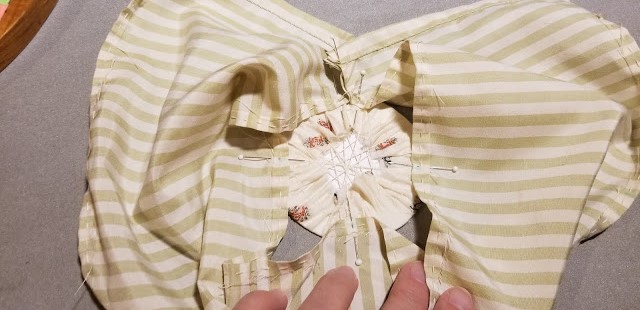
The body is pinned to an outside medallion at the quarter marks. Keep the 1" section of the body (below the ribbon channels) free from the medallions. When pinning the reticule body to the medallion, be sure the cut edge of the body (that has been folded and a gathering stitched sewn through it) sits in from the edge of the medallion.

Start pulling the gathering stitch (on the body) to fit each quarter section together. Gently adjust the gathers to be evenly distributed. Pin in place as you go.


All quarters have been gathered and pinned in place. Note the 1" sections that have not been pinned to the medallion at the top of the photo.


The pinned reticule from the right side. It is now ready to sew the first medallion in place.


Use a small slip-stitch to attach the gathered body to the silk-covered medallion. Try to catch only the edge of the silk on the cardboard piece, this will help hide your stitches. Be sure to use small stitches spaced close together for a strong seam. Continue all the way around the medallion.


Another shot of the stitches attaching the body to the medallion.


The first medallion is now completely sewn to the body.


The right side of the reticule after the first medallion is complete.

You will repeat the above steps to attach the other outer medallion to the body. Once the second outer medallion is attached then the reticule can be turned inside out and the interior medallions sewed down. Attaching the interior medallions are fairly simple to complete. Just lay one medallion on top of all the interior stitches (one on each side) and attach using a small slip stitch.


One interior medallion is sewn in place in the same way at the outer medallions.


The 1" sections that were not sewn to the medallions can either be left open or sewn together closing the 1" gap. I chose to sew the gap closed. Unfortunately, I did not get a photo of this step. Place the two outside folded edges together and sew a small whipstitch over the edges. 

The last step is to run your ribbon through the channels. You will need two ribbons the same length (however long you want your ribbon straps to be). Starting on one side, run your ribbon through the channel using a long needle-shaped bodkin. Once through the first channel, bring it around through the other channel and tie it off. Repeat this on the opposite side. You will have two ribbons that when pulled will close the reticule.


Tuesday, October 8, 2019

An 1829 Tea Cake


Look at that proud smile!
Recently my great-niece came to stay with me for a couple weeks. I wanted to give her something to remember about her crazy aunt who likes to dress up in old-time clothes and pretend she lives in the early 19th century. So, I took her to work with me and dressed her up too. One of the first activities we decide to do was cook in the 1820 kitchen. She was all for it, even if it was going to be hot. Of course, she turned out to be a natural historical interpreter: greeting visitors and telling them about our undertaking.

Our modern reprint.
The recipe we decided to make was a tea cake from The American Frugal Housewife by Lydia Maria Child. This cookbook was originally published in 1829. If you're interested in reading the entire book you can do so online here. It is also available to purchase from the Stephenson House's museum shop (at the historic site or online). Stephenson House has copies of several historic cookbooks in our site research library so we simply used a hard copy on hand.

The original receipt (aka recipe) is very short and very vague. I had experimented with this particular receipt once before but it didn't turn out as expected due to the leavening agent failing to activate.  After some additional research, I felt confident that this would not be the case this time.

Sometimes working with old cookbooks can be a challenge for various reasons. Two such reasons include:

1. the author assumes the reader has a basic knowledge of cooking practices of their day, therefore, leaving out the finer details of the receipt

2. some ingredients are no longer readily available

The recipe reads as follows:

Tea Cake.
There is a kind of tea cake still cheaper. Three cups of sugar, three eggs, one cup of butter, one cup of milk, a spoonful of dissolved pearlash, and four cups of flour, well beat up. If it is so stiff it will not stir easily, add a little more milk.


That's it. No information about temperature, cook time, what size cake pan, or if there is a certain method for combining the ingredients. Modern recipes are definitely more detailed. The receipt also called for "pearlash" (the 1820 version of baking soda that I purchased online here). As mentioned above, when I attempted to make this cake previously, the pearlash failed to activate. What I didn't know, at the time, was that pearlash needed something acidic like buttermilk to activate it. In my first attempt, I'd used regular whole milk which allowed me to create a very sweet, yet, unleavened brick.


The first thing we needed to do was start a fire in the hearth, as well as, the wall oven. Preheating the wall oven would require its fire to burn for several hours to heat the interior bricks to the required temperature for baking. While it was heating we'd amass all our ingredients.


I gave my niece the option of using store-bought butter and buttermilk or making our own. Of course, she wanted to "make it from scratch' (I was so proud...😍. Kid's gonna be as crazy as me someday).  That would take some time, which was good since it would be a while before the oven would be ready for baking. Fresh always tastes best anyway.

Churning butter in a small ceramic churn.
Once the butter and buttermilk were complete we could start putting everything together. We did not have a standard measuring cup in the 1820 kitchen so we used a tin cup from the cupboard. It was actually a little bit larger than a modern 8 oz measuring cup. As long as we used this cup throughout the receipt, it would work fine. The first ingredient to go into the bowl was three cups of sugar.

Measuring out three cups of sugar.

The eggs were the next thing to add. Now, I've done this two ways: one is simply putting the eggs directly into the bowl with the sugar or they can be beaten in a separate bowl then added. My niece is pictured adding them directly to the bowl but I prefer beating them first then adding them.


Egg option #1: Adding them directly to the bowl.
Egg option #2: Beat all three eggs in a separate bowl before adding them to the sugar.

Our freshly churned butter would go in next. The receipt does not say how to add the butter to the sugar.  Modern recipes sometimes tell you to 'cream' them together. Since we had chosen Egg Option #1, our sugar was still dry.  The butter was rather firm after churning and was not going to mix as easily as if it was soft.  We'd need to 'cut ' the butter into the mixture (to start) similar to how it's done to make a pie crust. Unlike pie crust, it would need to be thoroughly combined. The batter would become smoother as we added additional ingredients.

If we had used Egg Option #2 the mixture would have been wet and creaming it all together fairly easy.

Measuring a cup of our firm butter. The large bowl pictured was used to wash the butter after churning it.
One cup of butter going in.

Cutting the butter into the sugar. 

The batter looks like pie crust dough in this photo. It would not stay this way once the remaining items were added.

The recipe called for one cup of milk. As mentioned above, we needed to add a liquid that would activate the pearlash. Milk is not typically acidic unless it's sour or buttermilk. The recipe also mentioned that additional liquid may be necessary. We'd start with one cup of our fresh buttermilk and worked from there.

One cup of buttermilk added. 

Before combining the batter, the pearlash needed to be added. A spoonful of pearlash was put into the measuring cup then dissolved with some buttermilk. It's important to do this before adding it to the batter. Have you ever bitten into a piece of cake and gotten a mouthful of baking powder? YUK! 😝 Dissolving the pearlash would evenly distribute it throughout the cake batter as well as help prevent a mouthful of 'yuk'.


 Pearlash added to our measuring cup.


Adding buttermilk to the pearlash then stirring until dissolved.


Sugar, butter, pearlash, and buttermilk.

Now it was time to add the flour. Once that was done and mixed, it became obvious more buttermilk would be needed. The batter was to dry. We added more buttermilk a little at a time until we achieved a cake batter consistency. (See photos below)

Adding the flour to the bowl.

The flour had been stirred in but now it's too dry. More buttermilk would need to be added slowly.

The batter looked perfect after we added more buttermilk (almost an additional cup). This is how the batter should look once everything is combined.

This receipt makes a lot of cake batter. We prepared two different baking pans to accommodate the batter.  One of the pans was a bottomless cake ring. This type of cake pan was common in the early 19th century and it's easy to use. To enclose the bottom, we used some wax paper (parchment will work too) to cover one end and tie it in place with some cooking twine. Once the bottom was enclosed we thoroughly greased and floured the inside including the paper bottom.  The cake pan was then set on a tin baking sheet to give it some added stability (See photos below). Once pan prep was finished we poured half the batter into the ring and the other half into another pan (not pictured).


Cake ring before the paper bottom was tied on and the tin baking sheet.


Paper bottom tied in place. 

Half the cake batter was poured into the pan. 


It was time to put the cakes into the oven. I have a love/hate relationship with the beehive oven at Stephenson House.  The oven does not maintain its heat unless there is a small fire at the back of it (and I've tried every trick in the book). Baking without this small fire at the back is impossible. Traditionally, all the embers would be removed from a wall oven before food was put in then the door closed so everything would bake evenly. Unfortunately, that is not how our oven works...sigh. In the photo below you can see both cake pans and the small fire. To keep the cake baking evenly and the small fire burning, we partially close the door and rotate the pans every so often.


Two tea cakes baking in the oven (sounds like a verse from a nursery rhyme).


Today, the wall oven was being very contrary. Even though it had been thoroughly preheated and a small fire built in the back it would not stay hot. Two hours after putting the cakes into the oven, we took them out to find they weren't even close to done. Ultimately, we finished them off in the bake kettle. It took only about 30 minutes more bake-time after that before they were done. And I must say they turned out beautiful!


The cake ring in the bake kettle. We ended up finishing both cakes in the bake kettle since the wall oven would not maintain its heat. In this photo, we had just removed the lid (which is now sitting on the floor of the hearth).

The bake kettle is a small oven on short legs. Hot coals are placed under the kettle and on top of the lid. This allows heat to circulate around the food (placed inside the kettle) to bake. 


The first cake baked in the ring pan.


Cake number two baked in a mold pan.


The cakes turned out perfect! Needless to say, they didn't last long. The staff and volunteers at Stephenson House gobbled them up right away. My niece was so proud and rightly so. She worked hard all day to create them. Hopefully, she has this memory for a very long time... I know I will.


Enjoying the reward of her hard work.