Thursday, June 6, 2019

Wallpaper Boxes


Wallpaper boxes would have made excellent, as well as decorative storage containers in the early 19th century. Over the years, I have taught this project many times to children attending summer camps at the 1820 Col. Benjamin Stephenson House. It's an easy project to make on a small or large scale. You're only limited by the size of your wallpaper pieces. The photo above shows two small boxes made during Mrs. Lucy's Academy for Young Ladies in 2018. The larger box below was constructed several years ago for display in the master bedroom at the historic home.


Made from reproduction early 19th-century wallpaper and lined in photocopies of an 1819 Edwardsville newspaper. It's large enough to store a man's top hat inside.


Supplies:
·         Wallpaper sample books
·         Small cardboard boxes (available at Michaels, JoAnn Fabrics, Hobby Lobby)
·         Pencil
·         Ruler
·         Flour Paste (recipe at end of the post)
·         Small paint brushes
·         Scissors
·         Paper towels


A simple cardboard box and wallpaper samples.

Step 1. Choose the sheet of wallpaper you will be using. Pick a pattern that works well with the shape of your box. Think about how the wallpaper design can be used to highlight the box shape (e.g. trim around lid, center design on the lid, the body of the box). Be sure that there is enough of the sheet to completely cover your box. If necessary, pick another sheet to compliment the first one.


Step 2. On the wrong side of your wallpaper lay the box on its side with the bottom edge lined up with the straight edge of the paper. Take a pencil and mark the top edge of the box on the paper. It's hard to see in the photo below but there is a pencil line directly below the right edge of the box. 

You will also want to get an idea of how long of a strip you will need for the body. An easy way to do this is while your box is still in this position, mark the side edge of the paper on the box then roll the box until the mark comes back in contact with the paper. You’ll want to have at least ¼” overlap of paper for the side seam.


The pencil mark on the paper shows the top edge of the box.


Step 3.  Take your ruler and measure the distance from the bottom edge of the wallpaper to the pencil mark indicating the top edge of your box. Use this measurement to mark the width of your box the entire length of your wallpaper sheet then draw a straight line connecting your marks on the top edge.


Now measure ½” from your top edge (straight line) to create the cutline.


This image shows the width from the bottom edge to the top edge with 1/2" overlap at the top. The 1/2" overlap will be cut and folded in Step 4-6.

Box body wallpaper piece cut out.

Step 4.  On the top edge make cuts into the ½” allowance stopping about 2/16” from the top edge pencil line. Try not to cut all the way to the pencil line. This edge will roll over the top of your box edge to the inside. By leaving 2/16” uncut, you’ll have a nice smooth edge on the top of your box body.


Step 5. Coat your box body piece evenly with flour paste. Be sure to cover the entire piece.


Step 6. Lining up the bottom edges of the box and paper, slowly work the paper around the body of the box. There should be at least a ¼” seam overlap on the side of the box. Once the body is on, start folding over the top edges ½” allowance. If your glue has started to dry out just add a little more. To ensure the paper adheres to the box, gently work it with your fingers. If edges are not adhering, add a little more glue. Set the body aside to dry.

Here you can see the overlap of wallpaper along the side seam.

The top edge is coated with paste and being smoothed over to the inside of the box.
The top edge is now completely adhered to the inside of the box.


Step 7. Place your lid, on the wrong side of the wallpaper piece, on its side. Match the bottom or top edge of the lid to the straight edge of the wallpaper. Mark the side width of the lid on the wallpaper with a pencil. You will also want to get an idea of how long of a strip you will need for the side of the lid. An easy way to do this is while your lid is still in this position, mark the side edge of the paper on the box then roll the box until the mark comes back in contact with the paper. You’ll want to have at least ¼” overlap for the side seam.


Pencil mark indicating the top of the lid is rather hard to see in this photo.


Step 8. Take your ruler and measure the distance from the straight edge of the wallpaper to the pencil mark indicating the width of your lid. Use this measurement to mark the width of the lid the entire length of your wallpaper sheet.  Draw a straight line connecting your marks.


Now measure ½” from your straight line to create the cut line. This is the same as you did when measuring the body piece.


Add 1/2" to the width of the lid.


Step 9. In the ½” allowance, make cuts in the wallpaper stopping about 2/16” from the pencil line. Try not to cut all the way to the pencil line. This edge will roll over the bottom of the lid to the inside. By leaving 2/16” uncut, you’ll have a nice smooth edge on the bottom of your lid.

Set this piece aside for now. It will be added last.


Step 10.  Place the lid topside down on to the wrong side of the wallpaper. Draw a circle around the lid. Add ¼” -½” to this line all the way around. I would recommend the ½” since it will give you a little more to work with but if you don’t have enough wallpaper (as seen here) then a ¼” will do if you’re careful.


Step 11. As with the box body, make small cuts all the way around the pieces ½” allowance. Be sure not to cut all the way to the line. Leave 2/16” uncut for a smooth finished edge. Once you’ve created all the cuts then brush on the flour paste.


Step 12.  Place the lid onto the pattern piece being sure to keep the lid within the penciled circle. Start folding over the cut edge and smoothing it down. Again, work the surface with your fingers, smoothing and rubbing so the paper adheres to the cardboard. If necessary, add more paste.


Step 13. Coat your lid side piece evenly with flour paste. Be sure to cover the entire piece. Lining up the bottom edges of the lid and paper, slowly work the paper around the side of the lib. There should be at least a ¼” seam overlap on the side of the box. Once the side piece is on, start folding over the bottom edge’s ½” allowance. If your glue has started to dry out just add a little more. To ensure the paper adheres to the box, gently work it with your hands. If edges are not adhering, add a little more glue.
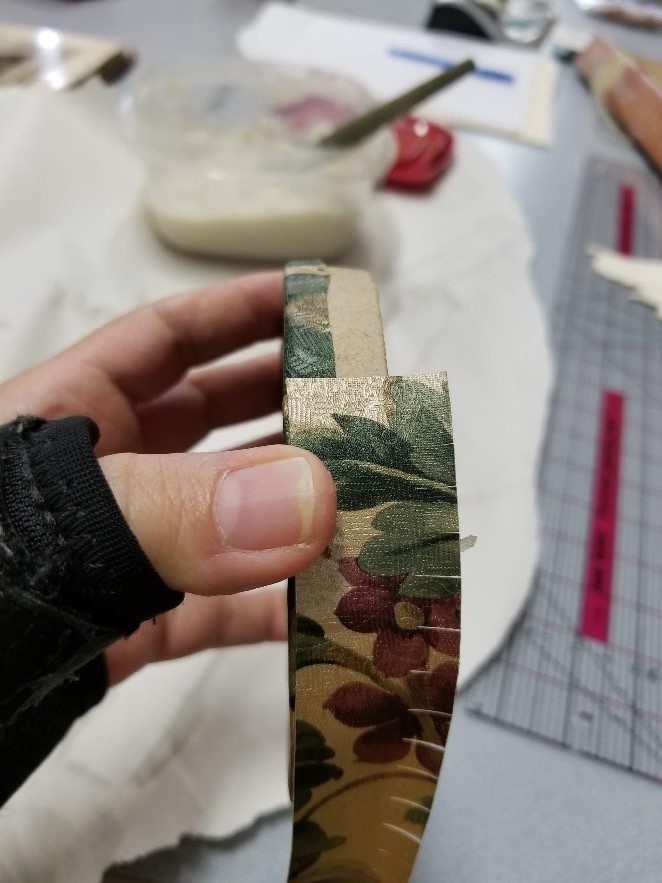


Side Note: In the event, you measured the length of the lid side wrong (like I did), you can easily add a piece to fill it in. Just cut it the same width as the lid side piece and 1/2” longer so you have a small overlap on each side.

I didn't measure correctly so the edge piece was too small.


The problem solved by adding a patch. The pattern of the wallpaper is busy enough to be unnoticeable.


Bookbinding Paste (historical recipe)

Use 1 part four (not self-rising) to 5 parts water. Heat just to simmer, stirring constantly (use a whisk like you're making a cream sauce). Add more water if necessary to get a thick cream/thin pudding consistency. DO NOT BOIL!! Cook until transparent. This paste will have a very strong bond.

Monday, May 27, 2019

A Period Patch

Mending clothes in the early 19th century would have been a regular occurrence. Just because you had a hole or a tear didn't mean you went out and bought something new or had a new one made up.  Hand sewing a garment took time. Shirts were typically well made since they were considered an undergarment and needed to hold up to washing.

Recently my husband asked me to repair one of his linen reenacting shirts. The poor old thing (the shirt not my husband) had developed a hole in the back shoulder area. It's a high-stress point for him since he removes his shirt by reaching over his shoulder then pulling forward. Apparently, I'd patched his shirt before since the evidence was staring me in the face (see next photo).

If you study original garments in museum collections then chances are you've come across some patchwork. The patch may or may not match the original fabric. About twenty-five years ago I learned how to patch garments in a period-appropriate fashion. In truth, I enjoy mending our historical (reenactment) clothes. Patches give the garment patina, make it looked lived in, and provides a more realistic interpretation of the past. As a docent at a historic site or weekend reenactor, clothing should look the part to be believable. If you're portraying a working-class person then your clothes would have wear and tear. Don't misunderstand, not everyone was running around in worn-out clothes but they wouldn't have all look like they'd just finished a new outfit either.

In the event, your garb requires a repair, here is a historical way to mend it.

In this photo, you see the first repair I made to the shirt a few years back. It held up very well but the area around it did not. I gave some serious thought to just adding another patch to this area; essentially creating a patch on patch look which is very common on original clothing.  But, I decided to go ahead and cut out the worn area along with the old patch.

In my stash of remnants, I had the perfect piece of linen to match the shirt. I literally have three drawers full of scraps leftover from previous sewing projects.  The linen on my hand is the scrap piece to be used as the patch and the shirt to be repaired is underneath.


Here the worn section (and some extra) has been completely removed. I ended up making the hole much larger than the actual tears. Upon closer examination of the fabric surrounding the torn area, I found it was very thin. My husband wears this shirt a lot throughout the year. Constant sweat and stress to the area caused the fabric to 'thin' so I went ahead and cut out the weak areas in hopes that the mend would last longer.

NOTE: This view is of the outside of the shirt.


Lay the scrap piece on top of the cut hole. In this case, the hole is visible through the scrap linen.  If your fabric is not sheer enough then you'll need to measure the hole and patch more precisely...I prefer the highly technical "eyeball" method, as seen here. This hole is rather large so the patch needs to be larger than the hole by roughly 1/2"-5/8" all the way around. It can be smaller but you need enough fabric to fold over the patches cut edges about 1/4", as well as, fold over the cut edges of the hole 1/8"-1/4".

NOTE: This view is of the outside of the shirt.


My patch is cut out.

NOTE: This view is still the outside of the shirt.


Press all four sides of the patch piece over about 1/4". 
If this was a printed fabric, this would be the side to show through the hole (so the right side of the fabric)


Turn the shirt inside out and place the patch over the hole being sure it is centered over the hole. It is important the patch is centered!! Double-check that there is at least 1/2" distance from the cut edge of the hole to the folded edge of the patch. The pressed edge of the patch (previous step)  is now against the shirt.  Be sure that the shirt fabric (beneath the patch) and the patch are pressed flat. You don't want either to be bunched or wrinkled.

NOTE: The shirt is now inside out.  


Pin the patch in place from this side.

NOTE: Shirt should still be inside out.

Sew a small whip-stitch all the way around the patch. 
Catch the folded edge of the patch and a few threads of the shirt for each stitch. Only a small stitch will show on the outside of the shirt. It's hard to see the stitching in this photo so refer to example 1 (EX1) & example 2 (EX2) below.

Note: This is still the inside of the shirt


EX1. Detail of whip-stitch with green thread on a scrap of white fabric. Catch the folded edge of the patch and a few threads of the shirt for each stitch. Only a small stitch will show on the outside of the shirt. 

EX2. Detail of whip-stitch with green thread from the outside. Only a small inconspicuous stitch will be visible on the outside.


The whip-stitch around the patch is complete. Keep your stitches small for stability. Give it a good press then turn the shirt right-side out.

The shirt has been turned right-side out. You can see the cut edge of the hole with the patch fabric in the middle. Give the area another pressing with the iron.

Fold under the cut edge of the hole and press. Try to fold the edge under at least a 1/8"-1/4"....this may be difficult in some spots but do your best. I find using a large pin or tip of my scissors to fold the edge under helps. See the next image.

Using the tip of my scissors to fold under the edge. I'm not cutting anything, just using the tip to push the edge under.

Once the edge is folded and pressed,  pin it in place and press again. Below is a video of the stitch I used next.

NOTE: I'm big on pressing if you hadn't noticed....😀


The video above shows how I stitch the folded edge of the hole to the patch underneath. I call it a 'reversed whip-stitch' (there's probably an official term but I don't know it).  Basically, I'm doing the whip-stitch, as before, but I don't want the slanted stitches to show on the outside of the shirt, just the small inconspicuous ones...so I reverse it. It's hard for me to explain. I hope the video helps to make it clear. Try to keep your stitching small. The smaller the stitch, the tighter the seam.


The tiny reverse whipstitch is complete around the hole edge. Press again.

NOTE: This is the outside of the shirt.
Sew a small running stitch around the outer edges of the patch. It should be about 1/8" in from the outside folded edge of the patch. You can do this from inside or outside the garment. In other words, either turn the shirt inside out to sew along the patch edge or from outside of the garment if the patch edge is discernible. Since I could see my patch edge from the outside of the shirt, I chose to sew from the right side.


Once the running stitch on the outside edge is complete, do the same thing on the hole edge. Keep the stitches about 1/8" from the folded edge of the hole. Sew with the garment right-side out.
The period patch is complete. It will probably last longer than the fabric around it.

Here you see how much bigger I cut the hole due to the thinning fabric around the tear. Ultimately, the mend will be stronger.


It's not as pretty as 'new' but my husband will get a few more years out of it...hopefully.


Saturday, March 16, 2019

How to Wear It: The Day Cap


HOW TO WEAR IT: The Day Cap

The day cap is an item of clothing that ladies of the early 19th century were very familiar with. It served a practical purpose as well as a fashionable one. Many female docents find wearing a day cap awkward. It oftentimes appears the cap is wearing them not the other way around. The trick to being comfortable and looking like it’s a part of your everyday ensemble is to know how to wear it properly.

The first thing to consider is the purpose of the caps. There was a wide range of day caps worn by our ancestresses. Some were worn at specific times of day or specific times in life. When choosing a day cap think about who you are portraying and what you're interpreting. A fashionable cap of expensive lace and ribbons is probably not going to be worn by a laundress or field-hand.


Do you like the cap you're wearing? Does it suit you? Not every cap looks becoming on every face. If possible, try on a variety of different styles to find one that feels right and you like the look of. When you feel good in something it shows. There is a large selection of day cap styles in the Stephenson House wardrobe. Docents are encouraged to try them all. An important thing to keep in mind, as a docent, are interpreting the clothing of the time period in conjunction with the era. You want to give the illusion that these are your everyday clothes, not a costume.

Another thing to consider is whether the cap is the right size for your head. One size does not fit all in this case. If you have a cap that looks like it’s eating your head, then that’s a good indication it’s the wrong size. Some caps were originally cut fuller to accommodate more hair and others sat very close to the head. Many patterns on the market are based on measurements from extant caps. Resizing is a relatively simple thing once you know how a particular cap is constructed. Again, trying on House caps is a good way to check the fit since they are made straight from a pattern without modifications.

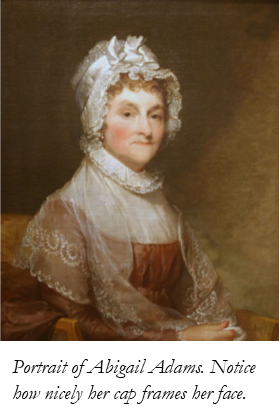
A day cap should frame your face not cover it up. The biggest mistake docents make is pulling the cap so far forward that it covers part of the forehead. Another no-no is wearing a cap like a chef’s toque. A day cap should sit on the back two-thirds of your head, not directly on top or over the forehead.


The early 19th century had a very distinctive day cap silhouette. When choosing a cap be mindful of fabric, shape and your hairstyle. A modern hair cut can drastically affect how a cap looks and fits.  Women in the 1820s typically wore their hair longer so it could be pulled back from the face and pinned up on the crown. Their caps were designed to accommodate this style. Docents can easily achieve a period profile while hiding a modern haircut underneath their caps. Stiffer, yet lightweight, fabrics such as organdy or well-starched linen will hold it’s shape without the need for a period coif for support. Whenever possible, modern hair should be pulled back from the forehead and hidden under the cap. Curls around the face are acceptable but not bangs. Bobby pins or headbands help to secure the hair when necessary. Don’t let a modern hairstyle destroy all the study, research and effort put into your historical interpretation.


It should be mentioned that day caps were not worn 24/7 by every woman. Ladies with fashionably dressed hair, often went with their hair uncovered. One historical myth often told at historic sites or by reenactors at events is that women who went without a cap were prostitutes...this is completely incorrect. Look at paintings from the period, there are lots of women from all social classes not wearing day caps.


Friday, January 6, 2017

The Art of Tying a Cravat: Noeud Gordien.


It has been my long-held belief that my husband is actually the reincarnation of Beau Brummel. He can be annoyingly precise about the fit and tailoring of his historical garments (so much so that, as his personal tailor, the thought has crossed my mind on occasion that a few forgotten sewing pins left in strategically placed seams might be warranted). One area where he lacks Brummel's skill as a fashionable perfectionist is in his ability to tie a neckcloth or cravat. But, he is okay with this deficiency since he has me to apply the finishing touch to his 'dandyism'. 

This year for Christmas I gave my husband a copy of the 1828 publication by H. Le Blanc, The Art of Tying the Cravat: Demonstrated in Sixteen Lessons, Including Thirty-two Different Styles. My thought, when purchasing this book, was he might learn how to tie his own neckcloth without following me around in a perpetual state of undress at reenactments or prior to the start of a special event at Stephenson House.  Although he did read the book, the natural dexterity it takes to tie a proper knot is a skill he doesn't possess. So, fair reader, my plight as Beau's neckcloth-tying servant shall continue despite my best efforts.

One of the many knots presented by H. Le Blanc is called the Noeud Gordien; or Gordian Knot. The original 1828 publication came with five illustrated plates for the reader to reference how to tie the various styles. Unfortunately, the reprinted book does not include the original illustrations. Luckily after some internet trolling, I stumbled across another blog that had uploaded all five original plates (and provided a wonderful article on "The Art of Tying the Cravat") which allowed me to download and print them all. Obviously, the addition of the plates makes figuring out the techniques much easier.

The Noeud Gordien is a simple knot to accomplish (unless you're my husband).  The following excerpt is taken in its entirety from a copy of the original 1828 publication by H. Le Blanc, “The Art of Tying the Cravat: Demonstrated in Sixteen Lessons, Including Thirty-two Different Styles”. The accompanying modern images are my interpretation of those shown in Plate B and are provided to aid in the visual demonstration of the original technique.

 The original illustration of Plate B from H. Le Blanc 1828 publication "The Art of  Tying the Cravat: Demonstrated in Sixteen Lesson, Including Thirty-two Different Styles".


Noeud Gordien.
[Plate B, fig. 6, 7, 8, 9, 10, and 11.]
     It would be very difficult to offer to our readers an exact and perfectly intelligible explanation of this most elegant style—-of the sovereign of Cravat ties, the Noeud Gordien, the origin of which is lost in the obscurity of antiquity.

     Notwithstanding the laborious researches we have bestowed on this interesting subject, we have hitherto been unable to discover the name of the genius to whom the honour of this invention is due. We only know (and it is, we believe, generally known) that Alexander the Great, irritated at being unable to comprehend the theory of its composition, and determined not to be foiled, adopted the shortest and easier method of solving the question—that of cutting it with his sword.

     In our own times we occasionally meet with young aspirants, who, in the fullest acceptation of the term, adopt the Gordian tie; with this difference, however, that when they wish to untie it, as a sword like that of the Macedonian monarch is too cumbersome for their delicate hands, they make use of a pair of scissars, with which they are more familiar—but to our subject.

     We confess, with regret, that we can only speak imperfectly of this interesting tie ; but as theory is nothing when compared to practico, we will endeavour to address ourselves to the eyes, rather than to the judgment of our readers, in the conviction that, though we may be unable to accomplish our object entirely, we shall, at least, approach it as nearly as possible. Attention !


My version of the cravat/neckcloth shown in Plate B, Fig 6, measures 68" long by 6" wide. I have folded and pressed it to resemble the illustration. There are no measurements provided in the 1828 publication since cravat/neckcloth size was dependent on the style of the knot being tied; some required longer cloths and others shorter.


PROBLEM.

     In the first place, the Cravat for this tie must be of ample size, and properly starched, ironed, and folded (as shewn plate B, Fig. 6); whether it be plain or coloured is of little consequence; but a rather stout one should be preferred, as it will offer more facilities to the daring fingers of the beginner who attempts to accomplish this chef-d’ ǽuvre.

     It will then be necessary to meditate deeply and seriously on the five following directions.
Figure 7. My cravat/neckcloth was slightly wider than the 1828 illustration so I created a horizontal fold at the center front to make it fit the neck. The fold will be covered once the cravat is tied.

     I. When you have decided on the Cravat, it must be placed on the neck, and the ends left hanging (as shewn plate B, Fig. 7, first time).

Figure 8.  I have used a yellow-headed pin to indicate "K" from the original illustration and a pink-headed pin to indicate "Z".


     II. You must take the point K, pass it on the inside of the point Z, and raise it (same plate, Fig. 8, second time).


Figure 9. Bring "Z'" underneath "K" and out the other side. An opening will be formed between the two tails (seen between the yellow and pink pins)

     III. You lower the point K on the tie, now half-formed 0 (same plate, Fig. 9, third time).

Figure 10. Take the tail of "K" up behind "Z" and through the center of the opening created in Figure 9. My hand is holding "K" after it was brought through the opening.


     IV. Then, without leaving the point K, you bend it inside and draw it between the point Z, which you repass to the left, Y; in the tie now formed, Y, O, you thus accomplish the formation of the destined knot.

Figure 10.5. This image is not represented in the original plate but is discussed in the section below. It shows the knot after it has been tightened

     V. and last. After having tightened the knot, and flattened it with the thumb and forefinger, or more properly with the iron, mentioned in the preceding lesson (see plate A, Fig. 5) ; you lower the points, K, Z, cross them, and place a pin at the point of junction H, and at once solve the problem of the Noeud Gordien.

Figure 11. The finished knot. I did not have a nice tie pin to hold the tails together so I improvised with my pink-headed sewing pin.

     He who is perfectly conversant with the theory and practice of this tie, may truly boast that he possesses the key to all the others, which are, in fact, derived from this alone. A Cravat which has been once worn in this way, can only be used afterwards en negligé, as it will be so much tumbled by this intricate arrangement.

     The slightest error in the first fold of this tie will render all succeeding efforts, with the same handkerchief, entirely useless—we have said it.

     We would, therefore, seriously advise any one who really desires to be initiated in the mysteries of this delightful science, to make his first essay on a moderate sized block. We can confidently assure him that, with moderate perseverance, he will soon be enabled to pursue his studies with pleasure and advantage—on himself.

(A careful examination of the figures referred to in this lesson is strongly recommended).